
Large Ring vs. Small Ring Mauser Actions: How to Tell the Difference
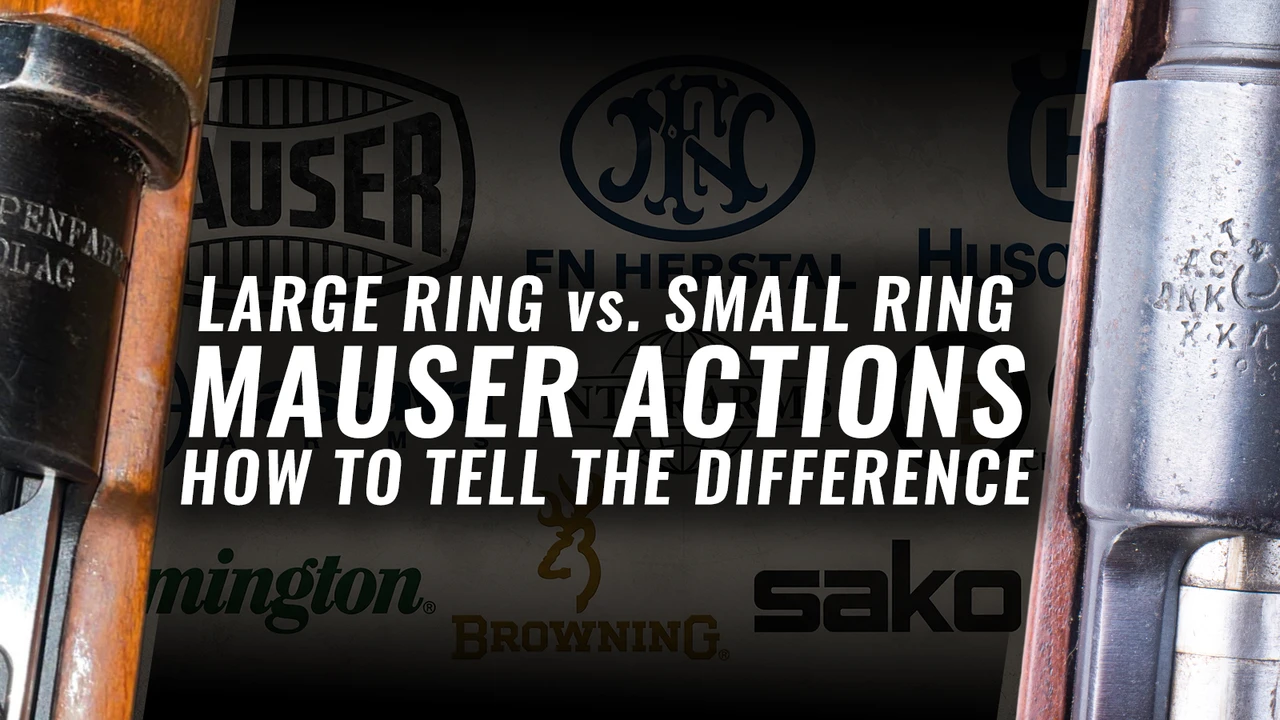
Large Ring vs. Small Ring Mauser Actions: How to Tell the Difference
The Mauser bolt-action rifle is one of the most recognizable and influential firearm designs in history. From military rifles produced more than a century ago to modern sporting rifles, Mauser-style actions have earned a reputation for reliability, durability, and versatility.
However, not all Mauser actions are the same.
One of the most important distinctions is the difference between large ring and small ring Mauser actions. Although they share many design characteristics, their receiver dimensions and configurations differ. These differences are particularly important when selecting replacement parts, rifle stocks, or scope mounts.
Whether you're restoring a military surplus rifle, working on a sporterized Mauser, or installing a modern Picatinny rail, correctly identifying your action is an essential first step.
In this guide, we'll explain what separates large ring and small ring Mauser actions, how to identify each type, and what to consider when selecting a scope mount for your rifle.
Quick Check: Small ring Mauser receivers typically measure approximately 1.300 inches across the front receiver ring, while large ring Mausers measure approximately 1.410 inches. Always verify your receiver configuration and mounting hole spacing before ordering a scope mount.
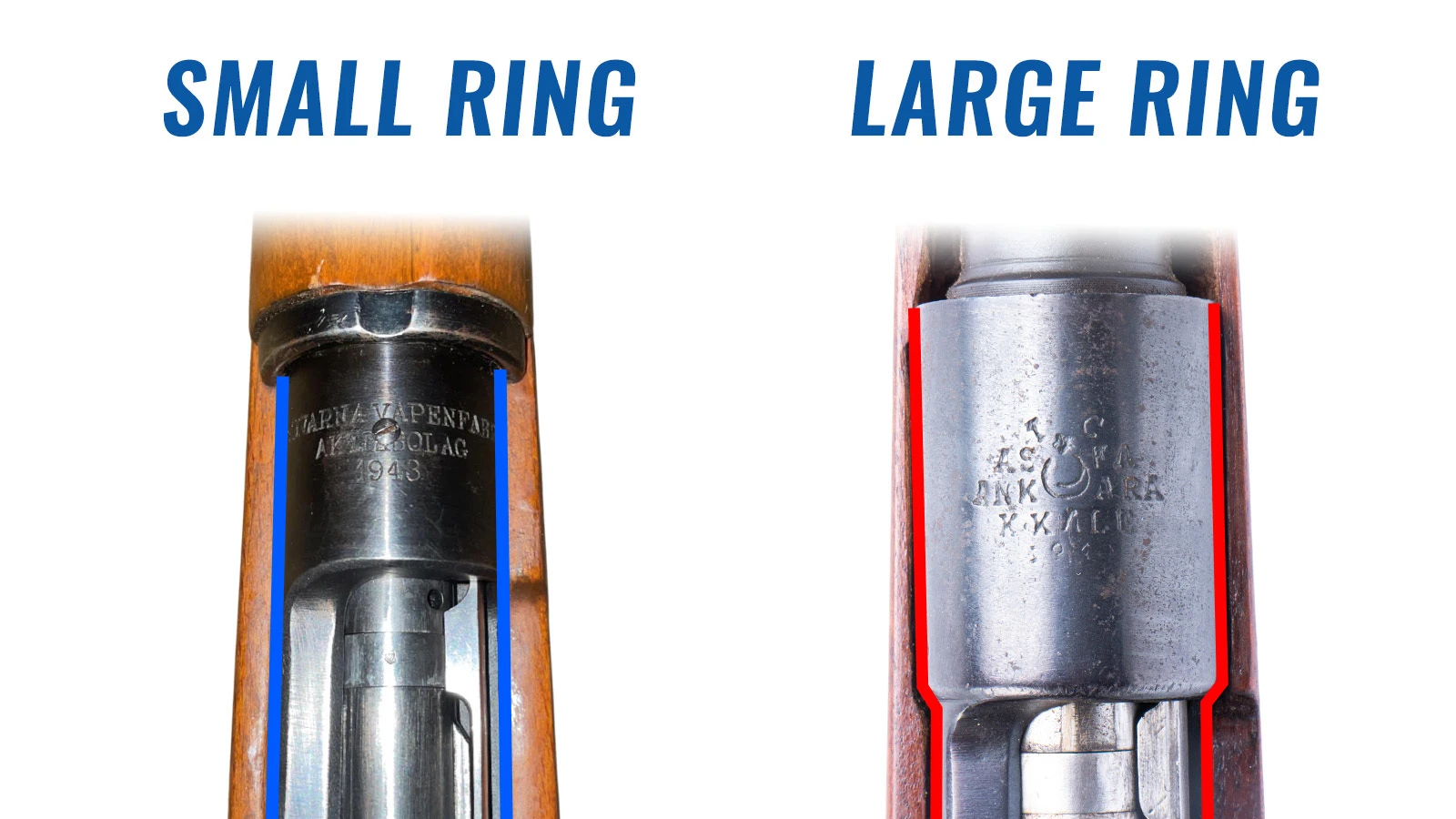
Comparison of small ring and large ring Mauser receivers. Notice the difference in the front receiver ring profile and the pronounced shoulder on the large ring action.
What Is the Receiver Ring on a Mauser Action?
The receiver ring is the enlarged section at the front of the rifle's receiver where the barrel attaches.
On Mauser-style bolt-action rifles, the barrel threads into this portion of the receiver. The outside diameter of this area is what determines whether an action is classified as a large ring or small ring Mauser.
Small Ring Mauser
1.300"
Approximate Front Receiver Ring Diameter
Large Ring Mauser
1.410"
Approximate Front Receiver Ring Diameter
While the difference is only 0.110 inches, it significantly changes the external profile of the receiver and can affect the compatibility of certain components.
Importantly, the terms large ring and small ring describe the receiver's outside diameter. They do not necessarily identify the action's overall length, barrel thread dimensions, or internal mechanical design.
Large Ring vs. Small Ring Mauser: Key Differences
Although both types share the basic Mauser bolt-action operating principle, their receiver profiles and common model configurations differ.
| Feature | Small Ring Mauser | Large Ring Mauser |
|---|---|---|
| Front Ring Diameter | Approx. 1.300" | Approx. 1.410" |
| Receiver Appearance | More uniform profile | Noticeably enlarged front ring |
| Common Models | Mauser 1893, 1895, Swedish 1896 | Mauser 98, Gewehr 98, K98k, VZ24 |
| Typical Design Family | Earlier pre-98 actions | Model 98 pattern actions |
| Scope Mount Compatibility | Requires a compatible small-ring mount | Requires a compatible large-ring mount |
These are general characteristics rather than universal rules. Mauser actions were manufactured in numerous countries over many decades, and certain models do not follow the usual classifications.
What Is a Small Ring Mauser Action?
Small ring Mauser actions are commonly associated with earlier Mauser rifle designs developed before the introduction of the Model 98.
The defining characteristic is a front receiver ring measuring approximately 1.300 inches in outside diameter.
On most small ring Mausers, the receiver has a relatively uniform external profile. Looking at the action from the side, the front receiver ring does not have the pronounced enlargement commonly found on large ring actions.
Common Small Ring Mauser Models
- Mauser Model 1893: Commonly associated with Spanish Mauser rifles.
- Mauser Model 1895: Used by several countries, including Chile.
- Swedish Mauser Model 1896 (M96): A well-known small ring action chambered in 6.5×55mm Swedish.
- Swedish Mauser M38: A shorter Swedish rifle built around the small ring action design.
Many earlier small ring Mausers use a cock-on-closing bolt system and lack some of the additional safety features introduced with the Model 98.
However, not every small ring action is a pre-98 design. Certain later Mauser 98-pattern rifles were also manufactured with small receiver rings.
The Mexican Models 1910 and 1936 are examples of small ring Mausers that incorporate Model 98-style mechanical features.
What Is a Large Ring Mauser Action?
Large ring Mauser actions are most commonly associated with the Model 98 design.
The defining characteristic is a front receiver ring measuring approximately 1.410 inches in outside diameter.
Unlike the relatively straight exterior profile of a small ring action, a large ring Mauser typically has a noticeable enlargement at the front of the receiver.
This creates a visible step where the front receiver ring meets the narrower portion of the receiver behind it.
Common Large Ring Mauser Models
- Mauser Gewehr 98: The original German military Model 98 rifle.
- Karabiner 98k (K98k): The widely recognized German military carbine.
- Czech VZ24: A military rifle based on the Model 98 action.
- FN Mauser 98 Actions: Used in numerous commercial and military rifle configurations.
- Interarms Mark X: A commercial sporting rifle built on a Mauser 98-style action.
The Model 98 introduced several important mechanical improvements over earlier Mauser designs, including a third safety lug, improved gas-handling provisions, and a cock-on-opening bolt system.
The larger receiver ring also provides additional material around the barrel shank and receiver's front locking area.
These characteristics contributed to the Model 98's enduring popularity as the foundation for military rifles, commercial sporting rifles, and custom rifle builds.
How to Tell if Your Mauser Is Large Ring or Small Ring
If you're unsure which Mauser action you have, there are several ways to identify it.
1. Examine the Front Receiver Ring
The easiest visual indicator is the transition between the front receiver ring and the rest of the receiver.
Large Ring: Look for a noticeable step or enlarged section where the barrel attaches to the receiver.
Small Ring: Look for a more uniform receiver profile, with little or no visible enlargement at the front ring.
This visual difference is often enough to make a preliminary identification.
2. Measure the Receiver Ring Diameter
For a more reliable identification, use a set of calipers to measure the outside diameter of the front receiver ring.
Make sure the firearm is completely unloaded before inspecting it.
- A measurement near 1.300 inches generally indicates a small ring action.
- A measurement near 1.410 inches generally indicates a large ring action.
Measure the receiver itself rather than the barrel, stock, or barrel shank.
If the stock prevents an accurate measurement, have a qualified gunsmith inspect the rifle rather than attempting unfamiliar disassembly.
3. Identify the Rifle Model
Receiver markings, manufacturer information, and military designations can provide additional clues.
For example, a Swedish M96 will generally have a small ring receiver, while a German K98k will typically have a large ring receiver.
However, identifying a rifle solely by its manufacturer or model designation can sometimes be misleading.
Some military rifles were rebuilt, rebarreled, or converted into sporting rifles. Additionally, several Mauser variants were manufactured with dimensions that differ from the more common designs.
4. Check the Receiver Configuration
When identifying an action for mounting purposes, consider more than just the diameter of the receiver ring.
Other important details include:
- Overall receiver length
- Front receiver ring contour
- Rear receiver bridge configuration
- Existing scope mount hole spacing
- Presence of a military stripper clip guide
- Previous gunsmithing or receiver modifications
These details help determine whether a particular scope mount will fit your rifle correctly.
Military vs. Commercial Mauser Actions: What's the Difference?
Another important distinction when identifying a Mauser rifle is whether it has a military or commercial receiver configuration.
Although military and commercial Mauser actions often share the same basic design, they can have different receiver contours, bolt configurations, and scope mounting requirements.
This is particularly important with large ring Mauser 98 actions, which were manufactured for both military service and commercial sporting rifles.
Quick Check: The easiest place to begin identifying a military versus commercial Mauser 98 receiver is the rear receiver bridge. Military actions commonly have a raised stripper clip guide, sometimes called a stripper clip hump. Commercial sporting actions generally have a smoother rear bridge without this feature.
Military Mauser Actions
Military Mauser actions were originally manufactured for service rifles used by armed forces around the world. These rifles were designed with features that supported military use, including the ability to quickly reload using ammunition held in stripper clips.
One of the most recognizable characteristics of a military Mauser receiver is the raised stripper clip guide located on the rear receiver bridge.
This raised section contains the guide used to position a stripper clip above the magazine, allowing the shooter to push cartridges directly into the rifle's internal magazine.
Common characteristics of military Mauser actions include:
- Raised stripper clip guide on the rear receiver bridge.
- Stripper clip loading provisions, often including a thumb clearance cutout.
- Military-style bolt handles, which may be straight or turned down depending on the model.
- Military-style safety and magazine floorplate configurations.
- Receiver contours and mounting surfaces intended for the original military rifle configuration.
Examples include the German Gewehr 98, Karabiner 98k, Czech VZ24, and numerous other military Mauser-pattern rifles.
Many military Mauser receivers were not originally drilled and tapped for modern scope mounts. Some were modified later by gunsmiths or converted into sporting rifles.
Commercial Mauser Actions
Commercial Mauser actions were manufactured primarily for sporting and hunting rifles rather than military service.
Although many commercial Mauser 98 actions retain the same fundamental operating design as their military counterparts, they frequently feature changes intended to accommodate sporting rifle configurations and modern optics.
One of the most significant differences is the rear receiver bridge. Commercial Mauser receivers typically do not have the raised stripper clip hump found on military actions. Instead, the bridge is generally smoother or flatter, depending on the manufacturer and model.
Common characteristics of commercial Mauser actions include:
- A smoother or flatter rear receiver bridge without the traditional military stripper clip hump.
- Receiver contours designed for sporting rifle configurations.
- Turned-down or swept bolt handles that can provide additional scope clearance.
- Sporting-style safety arrangements and magazine floorplates, depending on the model.
- Factory or aftermarket scope mounting provisions on many models.
Common examples of commercial Mauser-pattern rifles include the Interarms Mark X, FN commercial Mauser actions, Remington 798, Zastava M70, and several sporting models manufactured using Mauser-pattern receivers.
However, commercial production does not guarantee identical receiver dimensions or mounting hole spacing between manufacturers.
Military vs. Commercial Mauser Comparison
| Feature | Military Mauser | Commercial Mauser |
|---|---|---|
| Original Purpose | Military service | Sporting and hunting rifles |
| Rear Receiver Bridge | Typically raised stripper clip hump | Generally smooth or flat |
| Stripper Clip Guide | Commonly present | Generally absent |
| Bolt Handle | Straight or turned down | Usually turned down or swept |
| Scope Mounting | Often requires aftermarket drilling and tapping | Many models have factory mounting provisions |
| EGW Rail Configuration | Military-profile rail for stripper clip hump | Commercial-profile rail for compatible sporting receivers |
These differences describe common configurations, not universal rules. Military receivers were frequently modified for sporting use, and commercial Mauser-pattern rifles were manufactured in several different configurations.
Why Military vs. Commercial Matters for Scope Mounts
Even when two Mauser rifles use the same large ring receiver diameter, their scope mounts may not be interchangeable.
The raised stripper clip hump on a military Mauser changes the profile of the rear receiver bridge. A scope mount designed for a smooth commercial receiver may not sit correctly on a military receiver with this feature.
EGW offers different Mauser 98 Picatinny rail configurations to accommodate these receiver differences.
These measurements are the published center spreads for the specific EGW rails linked above. They are not universal dimensions for every military or commercial Mauser receiver.
The mounting hole pattern, receiver bridge profile, and overall action configuration must all be verified before choosing a scope mount.
What About Sporterized Military Mausers?
A sporterized Mauser is a military rifle that has been modified for sporting or hunting use.
These modifications may include replacing the military stock, shortening the barrel, altering the bolt handle, installing a different safety, or drilling and tapping the receiver for a scope mount.
However, converting a military rifle into a sporting rifle does not automatically make it a commercial Mauser action.
A sporterized military Mauser may still retain its original raised stripper clip hump and military receiver contours. Alternatively, those features may have been removed or modified during the conversion.
This is why the rifle's current appearance, stock style, or bolt handle alone should not be used to determine which scope mount will fit.
EGW Fitment Tip: If you have a sporterized Mauser, examine the actual receiver rather than relying on the rifle's appearance. Check whether the stripper clip hump is present, verify the mounting hole spacing, and compare the receiver configuration against the specifications of the EGW rail you're considering. Minor fitment may be required on modified receivers.
Does Large Ring Mean Long Action?
No. Receiver ring size and action length are two separate measurements. A large ring Mauser is not automatically a standard-length action.
A Mauser can have a large receiver ring while using an intermediate-length action.
The Yugoslavian M48 is an excellent example.
Although it features a large ring receiver and incorporates Model 98-style design elements, the M48 uses an intermediate-length action rather than the standard-length configuration found on many other military Model 98 rifles.
Because of these dimensional differences, a scope mount designed for a standard-length Mauser 98 should not automatically be considered compatible with an M48.
This distinction is especially important when ordering one-piece scope mounts.
Are Large Ring Mauser Actions Stronger Than Small Ring Actions?
The large ring Mauser 98 design generally provides more material around the receiver's front ring than earlier small ring designs.
The Model 98 also introduced mechanical features intended to improve safety and reliability, including additional gas-management provisions and a rear safety lug.
However, receiver ring diameter alone does not determine the strength or safety of a rifle.
Factors such as manufacturing quality, steel condition, heat treatment, headspace, previous modifications, and the specific action design must also be considered.
Many small ring Mausers have provided reliable service for well over a century when maintained and used appropriately.
Safety Note: For older military surplus rifles, a qualified gunsmith should evaluate the firearm's condition and chambering before use. A larger receiver ring should never be treated as automatic approval for higher-pressure ammunition or caliber conversions.
Choosing the Correct Scope Mount for Your Mauser
If you're planning to install a modern riflescope on a Mauser, identifying the receiver ring size is only part of the process.
The scope mount must also match the receiver's physical dimensions, rear bridge geometry, and mounting hole pattern.
At Evolution Gun Works, we manufacture American-made Picatinny rails for several Mauser action configurations.
Mauser 98 Large Ring Commercial Actions
Our Mauser 98 Large Ring Picatinny Rail is designed for compatible commercial Mauser 98-style receivers.
These include a variety of FN, Interarms, Zastava, and other commercial Mauser-pattern actions listed on the product page.
Examples of compatible actions include:
- FN Mauser Actions
- Interarms Mark X
- Zastava M70 Mauser
- Remington 798
- JC Higgins Model 50 and Model 51
Mauser 98 Large Ring Military Actions
Military Mauser receivers may retain the raised stripper clip guide on the rear receiver bridge.
Our Mauser 98 Large Ring Military Picatinny Rail is designed for the corresponding military receiver configuration, including actions with the stripper clip hump.
Because military and commercial receiver contours can differ, selecting a mount based only on the words "Mauser 98" may result in an incorrect fit.
Swedish Mauser Small Ring Actions
For compatible Swedish Mauser rifles, EGW offers the Swedish Mauser 3-Hole Picatinny Rail.
This rail is specifically designed for the small ring military Swedish Mauser receiver configuration. Verify your receiver contour and mounting hole spacing before ordering.
Yugoslavian Mauser M48 Actions
The Yugoslavian M48 uses a different action configuration than a standard-length Mauser 98.
Our Yugoslavian Mauser M48 Picatinny Rail is designed specifically for the M48 receiver.
Installation requires the receiver to be properly drilled and tapped to the specified mounting pattern.
Important Fitment Information: Many original military Mausers were not factory-drilled and tapped for modern scope mounts. Professional gunsmithing may be required. Always verify receiver dimensions and mounting hole locations before purchasing or installing a rail. Minor fitment may be required, particularly on previously modified rifles.
For additional help identifying the correct mounting configuration, visit our Scope Mount Fitment Guide.
Frequently Asked Questions
How big is a large ring Mauser receiver?
A typical large ring Mauser has a front receiver ring measuring approximately 1.410 inches in outside diameter.
How big is a small ring Mauser receiver?
A typical small ring Mauser has a front receiver ring measuring approximately 1.300 inches in outside diameter.
Are all Mauser 98 actions large ring?
No. Although the majority of standard Mauser 98 actions use large receiver rings, some Model 98-pattern actions were manufactured in small ring configurations. The Mexican Models 1910 and 1936 are notable examples.
What is the difference between military and commercial Mauser actions?
Military Mauser receivers commonly have a raised stripper clip guide on the rear receiver bridge. Commercial Mauser sporting actions generally have a smoother or flatter rear bridge without this feature. Receiver contour and mounting hole spacing must be verified when selecting a scope mount.
Is a sporterized Mauser considered a commercial action?
Not necessarily. A sporterized Mauser may still use its original military receiver, even if the stock, barrel, bolt handle, or other components have been modified. Always identify the receiver itself before selecting a scope mount.
Will a large ring Mauser scope mount fit a small ring Mauser?
Generally, no. Large ring and small ring receivers have different external contours. Even when mounting hole measurements appear similar, the receiver geometry may prevent proper installation. A scope mount should be selected based on the exact rifle and receiver configuration.
Is the Yugoslavian M48 a large ring Mauser?
Yes. The Yugoslavian M48 uses a large ring receiver, but its intermediate action length distinguishes it from many standard-length Mauser 98 rifles.
Can I install a modern Picatinny rail on an older Mauser?
Yes, provided a compatible mount is available and the receiver can safely accommodate the installation. Depending on the rifle, drilling and tapping by a qualified gunsmith may be necessary.
Final Thoughts: Know Your Mauser Before Buying a Mount
The difference between large ring and small ring Mauser actions comes down primarily to the outside diameter of the front receiver ring.
Small ring Mausers generally measure 1.300 inches, while large ring Mausers measure 1.410 inches.
Although that difference may seem minor, it plays an important role in identifying the action and choosing compatible components.
Remember that receiver ring size does not tell the entire story. Action length, military or commercial receiver configuration, rear bridge design, and mounting hole spacing can vary significantly between Mauser models.
Taking a few minutes to identify your rifle correctly can prevent ordering the wrong parts and save considerable frustration during installation.
At Evolution Gun Works, we manufacture precision-machined Picatinny scope mounts in the USA for a wide range of classic and modern rifles.
Shop EGW Mauser Scope Mounts
Whether you have a small ring Swedish Mauser, a large ring Mauser 98, or a Yugoslavian M48, EGW offers precision-machined Picatinny rails designed for a variety of Mauser receiver configurations.
Browse our selection of American-made Mauser scope mounts and find the right mounting solution for your rifle.
Shop EGW Mauser Scope Mounts →Newest Guide & Blog Updates
Large Ring vs. Small Ring Mauser Actions: How to Tell the Difference
Large Ring vs. Small Ring Mauser Actions: How to Tell the Difference The Mauser bolt-action rifle i...

1911 Sear Spring Guide: Finger Function and Problems
The Complete Guide to the 1911 Sear Spring: What Each Finger Does and What Can Go Wrong The 1911 s...
Tired of Waiting on Beretta Factory Plates? Upgrade to EGW Direct Replacements
Upgrading Your Beretta 92 RDO: The Ultimate Direct-Replacement Optic Plates Tired of waiting on fact...
How to Verify Ruger No.1 Scope Rail Fitment Before Ordering
Ruger No.1 Scope Rail Fitment Guide How to use the EGW Ruger No.1 Radius Gauge and Hole Spacing Gu...

Marlin 1895 Mounting Solutions: The Ultimate Guide to Modernizing Your Lever Gun
Marlin 1895 & Henry Lever Action Mounting Solutions: Picatinny Rails, Scope Mounts & Red Dot Option...

Springfield Prodigy Mag Catch Upgrade - EGW HD Machined Tool Steel
Springfield Prodigy Mag Catch Upgrade: EGW HD Machined Tool Steel The ultimate upgrade for reliable...