
1911 Sear Spring Guide: Finger Function and Problems
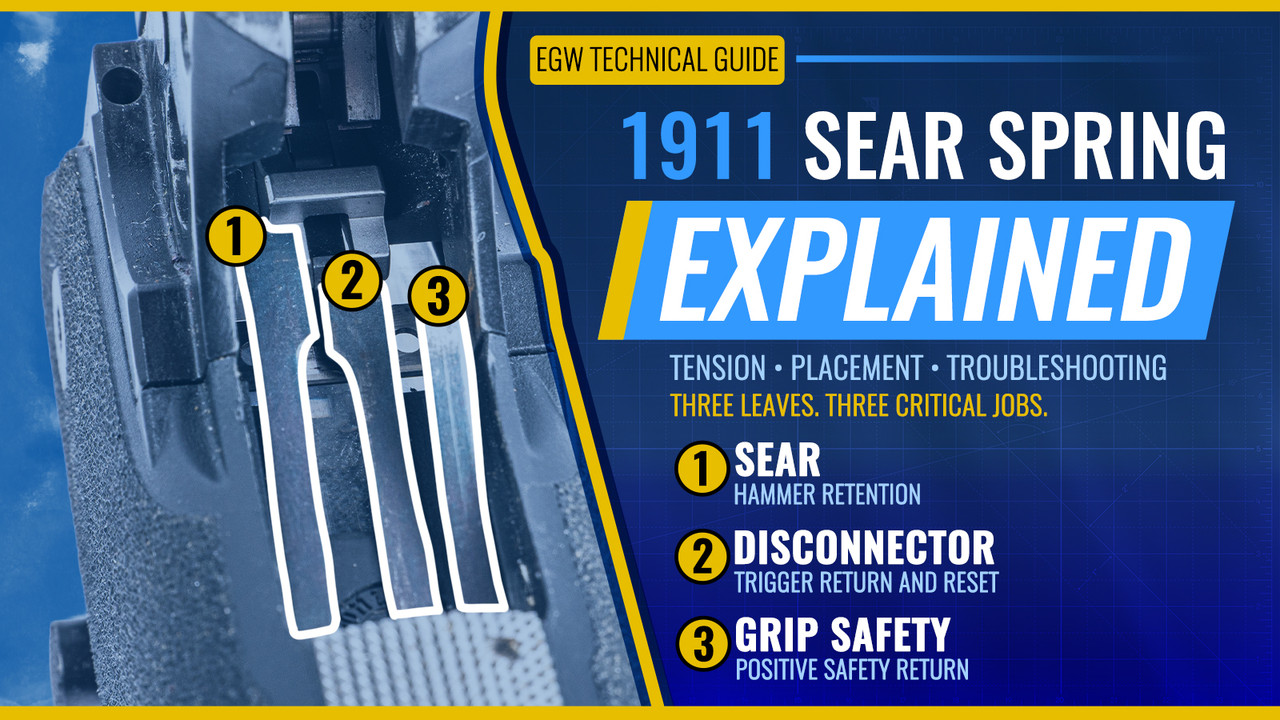
The Complete Guide to the 1911 Sear Spring: What Each Finger Does and What Can Go Wrong
The 1911 sear spring is a small, three-finger leaf spring that controls several of the pistol's most important firing and safety functions. Correctly fitted, it helps the sear retain the hammer, resets the trigger and disconnector, and returns the grip safety to its blocking position. Incorrectly tensioned or installed, it can produce anything from a heavy trigger or loose grip safety to hammer follow and unintended multiple shots.
Important safety warning
The sear spring is part of the 1911 fire-control and safety system. Improper installation, insufficient tension, damaged engagement surfaces, or an incorrectly fitted safety can allow hammer follow, multiple shots from one trigger press, or an unintended discharge. Always unload the pistol completely before inspection. Remove the magazine, verify the chamber is empty, and keep all ammunition out of the work area. Any pistol that fails a safety or function check must remain unloaded and must not be fired until inspected and corrected by a qualified 1911 gunsmith.
First, establish the viewing direction
Throughout this guide, left, center, and right are identified while looking at the sear spring from the rear of the pistol, with the spring installed in the frame and the grip safety removed. When a loose spring is turned around and viewed from its opposite face, the leaves appear reversed. This is one of the most common sources of confusion in diagrams, videos, and forum instructions.
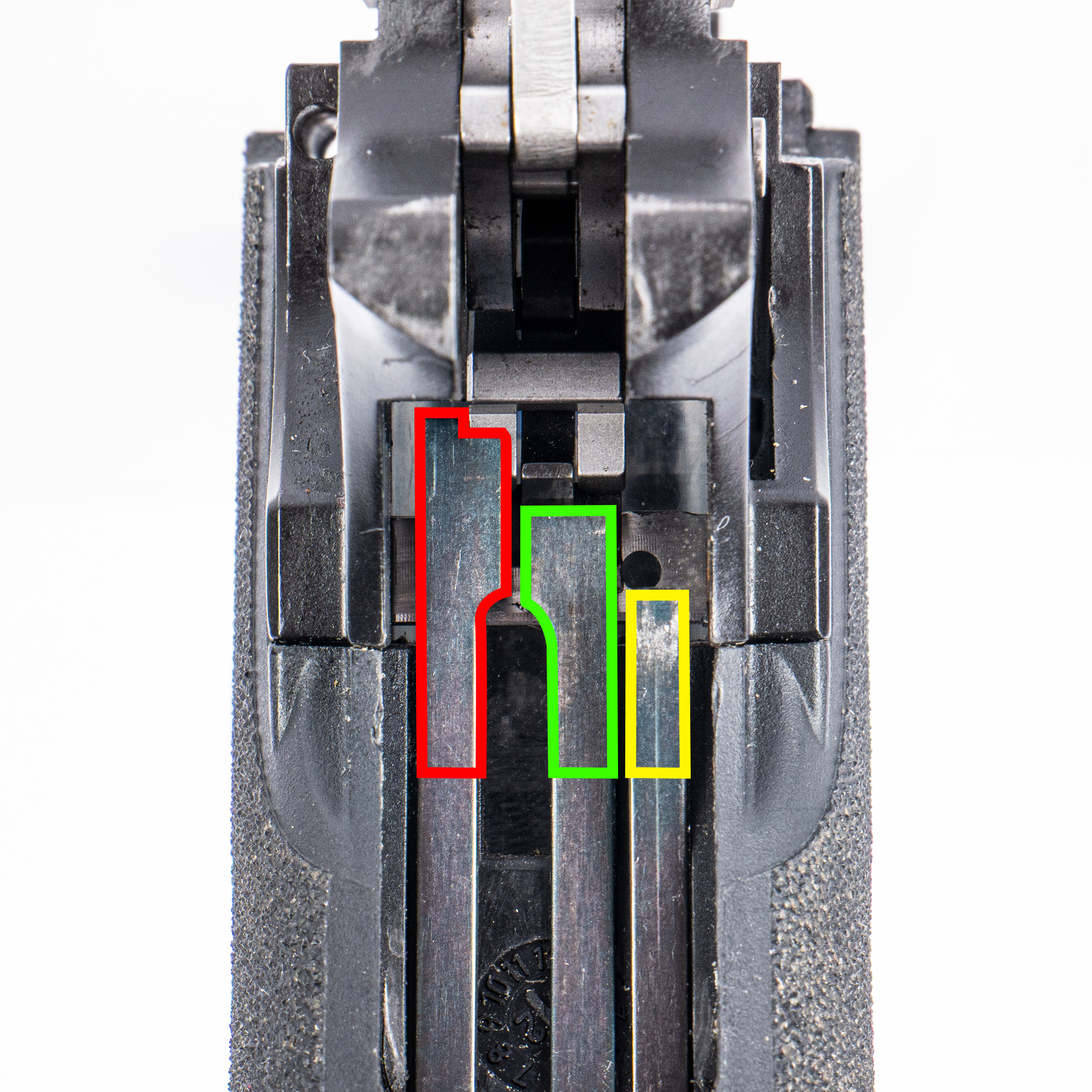
| Spring finger | Primary contact | Main job | Common low-tension symptom |
|---|---|---|---|
| Left leaf | Sear | Biases the sear toward the hammer hooks so the hammer can be retained | Hammer follow, failure to remain cocked, or inconsistent sear engagement |
| Center leaf | Disconnector | Raises the disconnector and returns the trigger forward | Weak or incomplete reset, dead trigger, or failure of the disconnector to re-engage |
| Right leaf | Grip safety | Returns the grip safety outward to its trigger-blocking position | Loose or rattling grip safety, or a grip safety that does not return positively |
The short version
The left leaf is primarily responsible for sear return and hammer retention. The center leaf controls the disconnector and trigger return. The right leaf controls grip-safety return. The left and center leaves also contribute to the measured trigger pull, while the right leaf normally affects how firmly the grip safety must be depressed. These functions are related, but the three leaves must remain mechanically independent. If leaves rub each other, miss their intended parts, or are tensioned to compensate for another defect, the pistol can become inconsistent or unsafe.
Why the 1911 Uses a Three-Finger Sear Spring
The sear spring is not simply a “trigger pull spring.” It is three springs sharing one body. Each leaf applies force to a different component, and each component must move at the correct time during firing, cycling, reset, and operation of the grip safety.
The lower tab of the spring seats in a slot in the frame. The mainspring housing supports and retains the spring from behind. As the housing is moved into its installed position, the spring is held against the frame and the leaves are placed under working tension. This means the spring's effective pressure is determined by more than its free shape on the bench. Frame dimensions, the location of the spring slot, the mainspring housing, the shape and length of each leaf, the contact points, and the installed parts all affect how the spring behaves.
For that reason, copying the visible bend of another spring does not guarantee the same installed tension. Two springs that look alike outside the pistol can behave differently once installed in two different frames.
How the Sear Spring Works Through the Firing Cycle
1. At rest with the hammer cocked
The left leaf presses on the sear and biases the sear nose into the hammer's full-cock hooks. The center leaf keeps the trigger forward and applies pressure to the disconnector so it can rise into its operating position when the slide is fully in battery. The right leaf pushes the grip safety outward, placing the grip safety's blocking arm behind the trigger bow.
2. When the pistol is gripped and the trigger is pressed
Depressing the grip safety moves its blocking arm out of the trigger bow's path. As the trigger moves rearward, the trigger bow acts through the disconnector to rotate the sear out of the hammer hooks. The trigger must overcome the working pressure of both the center leaf and the left leaf, in addition to friction and the mechanical forces created by the hammer, sear, disconnector, mainspring, trigger bow, and any firing-pin safety linkage.
3. While the slide cycles
As the slide moves out of battery, it pushes the disconnector downward. This interrupts the connection between the trigger and sear so the sear can return toward the hammer even if the shooter is still holding the trigger rearward. The left leaf must supply enough reliable sear pressure for the sear to capture the hammer as the slide completes its cycle.
4. During trigger reset
When trigger pressure is released, the center leaf helps push the disconnector and trigger system back to the ready position. The trigger bow moves forward, the disconnector rises when permitted by the slide, and the trigger reconnects with the sear for the next deliberate trigger press. A positive reset depends on adequate center-leaf tension and free movement of the trigger and disconnector.
The Left Finger: Sear Pressure and Hammer Retention
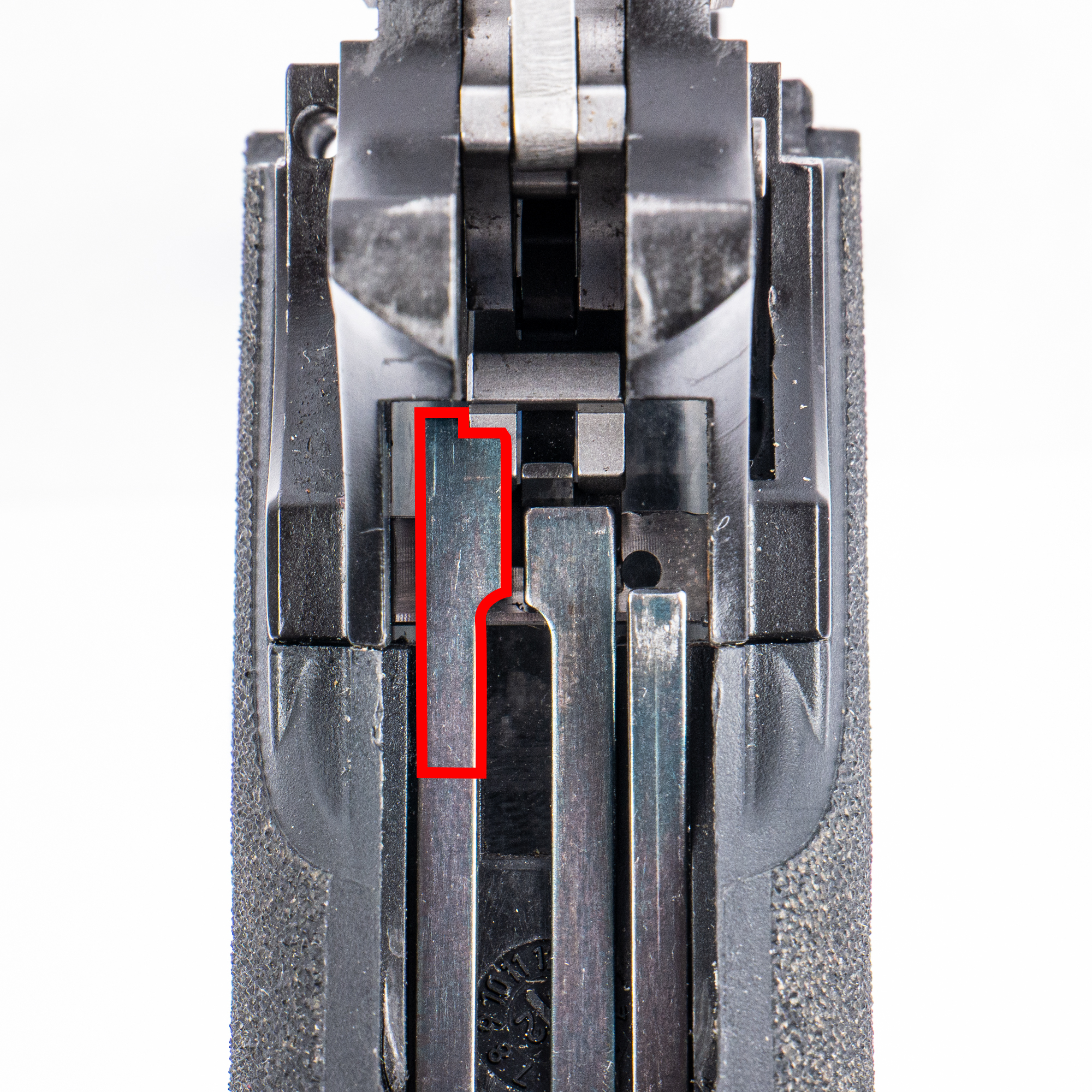
Viewed from the rear of the installed pistol, the left leaf bears on the sear. Its job is to rotate the sear toward the hammer hooks. This helps the sear re-engage the hammer after the trigger releases it and while the slide cocks the hammer during cycling.
The left leaf does not create safe hammer engagement by itself. Safe engagement also depends on correct hammer-hook and sear geometry, adequate engagement surface, proper pin locations, sound parts, and freedom from burrs or interference. The spring supplies the returning force. The hammer and sear geometry determine how those parts engage and hold.
What too little left-leaf tension can cause
- Hammer follow: The hammer may move forward with the slide instead of remaining fully cocked.
- Intermittent failure to cock: The pistol may work during slow hand operation but fail when the slide cycles at normal speed.
- Hammer stopping at the half-cock or safety position: This is a warning of a fire-control problem, not an acceptable operating condition.
- Unintended multiple shots: If the sear does not reliably recapture the hammer, the pistol may fire more than once from a single trigger press.
- Sensitivity to slide speed, ammunition, or how the pistol is handled: Marginal tension can produce inconsistent symptoms because the amount of time available for engagement changes with cycling speed.
Hammer follow is always a stop-use condition. It may be caused by insufficient sear-spring tension or incorrect spring placement, but it can also result from damaged or improperly cut hammer hooks, a worn or incorrectly fitted sear, disconnector problems, excessive trigger weight or inertia, incorrect trigger adjustment, or frame dimensional issues. Increasing spring pressure without identifying the cause can hide the symptom without correcting the unsafe geometry.
What too much left-leaf tension can cause
- A heavier trigger pull because more force is required to rotate the sear away from the hammer hooks.
- A stacking or less-refined feel as the trigger begins to move the sear.
- Accelerated rubbing at the leaf-to-sear contact point if either surface is rough, burred, or misaligned.
- A misleadingly “safe-feeling” heavy pull that masks poor hammer and sear geometry rather than correcting it.
Left-leaf placement problems
The left leaf must bear securely on the intended sear surface through the component's full operating movement. It must not sit behind the sear, slip under the sear leg, contact only an unstable edge, or rub the frame. The left leaf should also remain in front of the center leaf when the spring is viewed from the side. If the leaves cross or rub, the two spring functions are no longer independent and the pull can change unpredictably.
Frame variation matters here. If the frame's sear-spring locating slot is cut lower than intended, a conventional spring may sit too low for full, stable contact with the sear. The spring can appear installed while the left leaf is only partially engaging the sear. This is one of the dimensional problems addressed by the EGW Evolved 1911 Sear Spring, which uses a left finger more than .030 inch longer than many conventional designs.
The Center Finger: Disconnector Control and Trigger Return
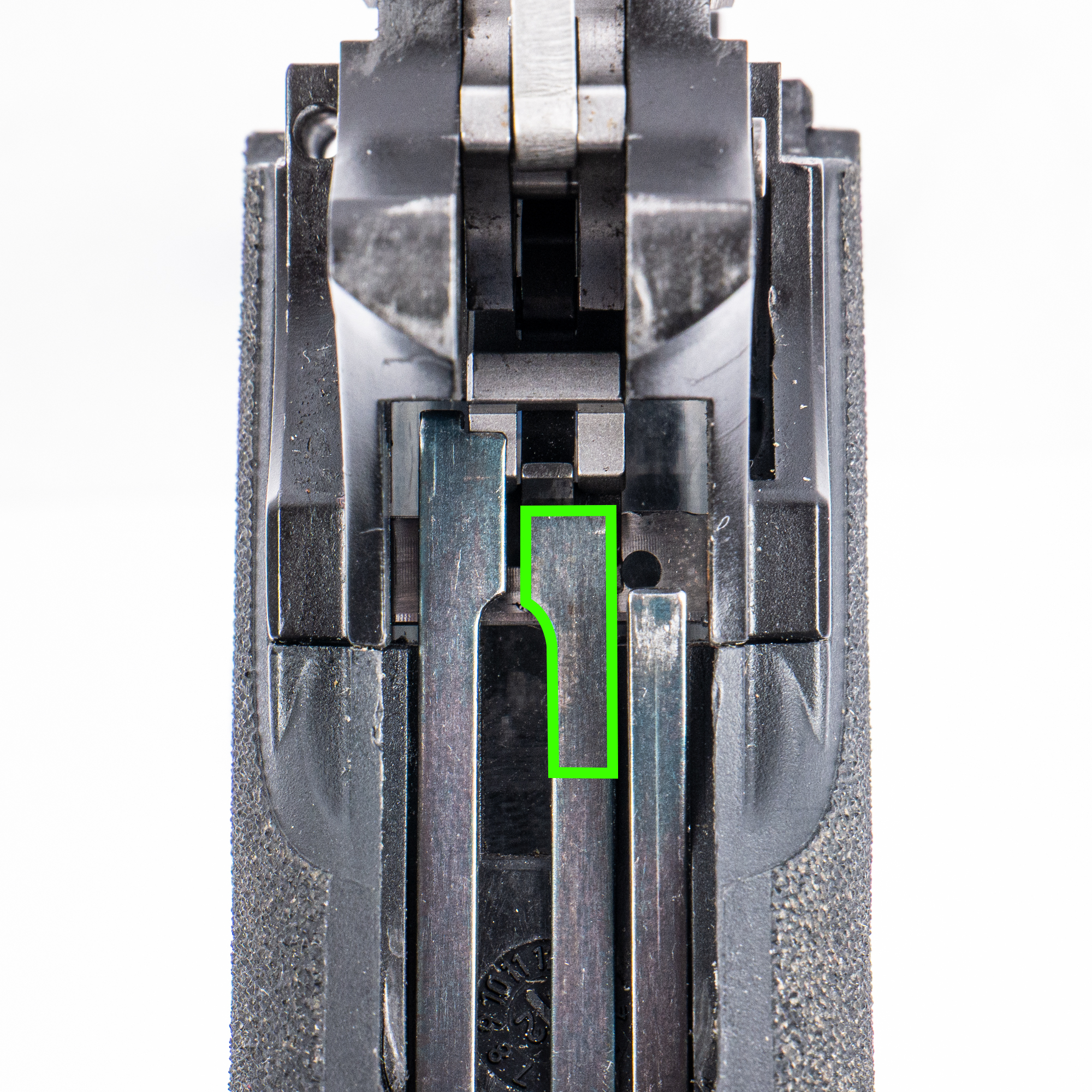
The center leaf bears on the disconnector. Its force has two important results. It helps the disconnector rise into its operating position when the slide is in battery, and it pushes the trigger system forward during reset. This is why the center leaf is often called both the disconnector spring and the trigger-return spring.
The disconnector is what allows the pistol to fire one shot for each deliberate trigger press. When the slide moves out of battery, the disconnector is pushed down so the trigger is temporarily separated from the sear. The center leaf must provide enough controlled pressure for the disconnector and trigger to return correctly when the slide and trigger positions allow it.
What too little center-leaf tension can cause
- Weak, slow, or incomplete trigger reset.
- A dead trigger after the slide cycles because the disconnector has not risen and reconnected the trigger to the sear.
- A trigger that must be pushed forward manually or that resets only when the pistol is moved or jarred.
- Intermittent reset caused by marginal pressure combined with dirt, burrs, a dragging trigger bow, or a tight disconnector channel.
- Increased risk of hammer follow in a very light trigger system. A heavy trigger shoe, minimal pretravel, aggressive overtravel adjustment, or insufficient trigger-return pressure can allow inertia to move the trigger system during slide closure.
What too much center-leaf tension can cause
- A heavier overall trigger pull because the trigger must work against greater disconnector and return pressure.
- An unnecessarily forceful reset that may feel abrupt rather than clean.
- Additional friction or a gritty sensation if the disconnector pad, trigger bow, frame track, or spring contact surface is rough.
- Premature wear or peening at an already misaligned contact point.
Center-leaf placement problems
The center leaf must contact the correct surface of the disconnector and remain centered enough that it cannot slide off during operation. If it is trapped under, beside, or behind the intended disconnector contact point, the pistol may have no trigger reset, an unusually heavy pull, limited disconnector movement, or intermittent operation.
The center leaf must also move without touching the left leaf or dragging heavily on the frame. Sideways warping can change the effective tension and couple the sear and disconnector functions together. A spring that looks properly curved from the side can still be defective if a leaf is twisted out of plane.
The Right Finger: Grip-Safety Return
The right leaf bears on the grip safety and pushes it outward when the pistol is not being gripped. In that outward position, the grip safety's blocking arm should prevent the trigger bow from moving far enough to fire the pistol. When the shooter depresses the grip safety, the blocking arm moves out of the trigger's path.
Unlike the left and center leaves, the right leaf normally does not determine the trigger's break weight once the grip safety is fully depressed. It determines how positively the grip safety returns and how much pressure the shooter must apply to depress it.
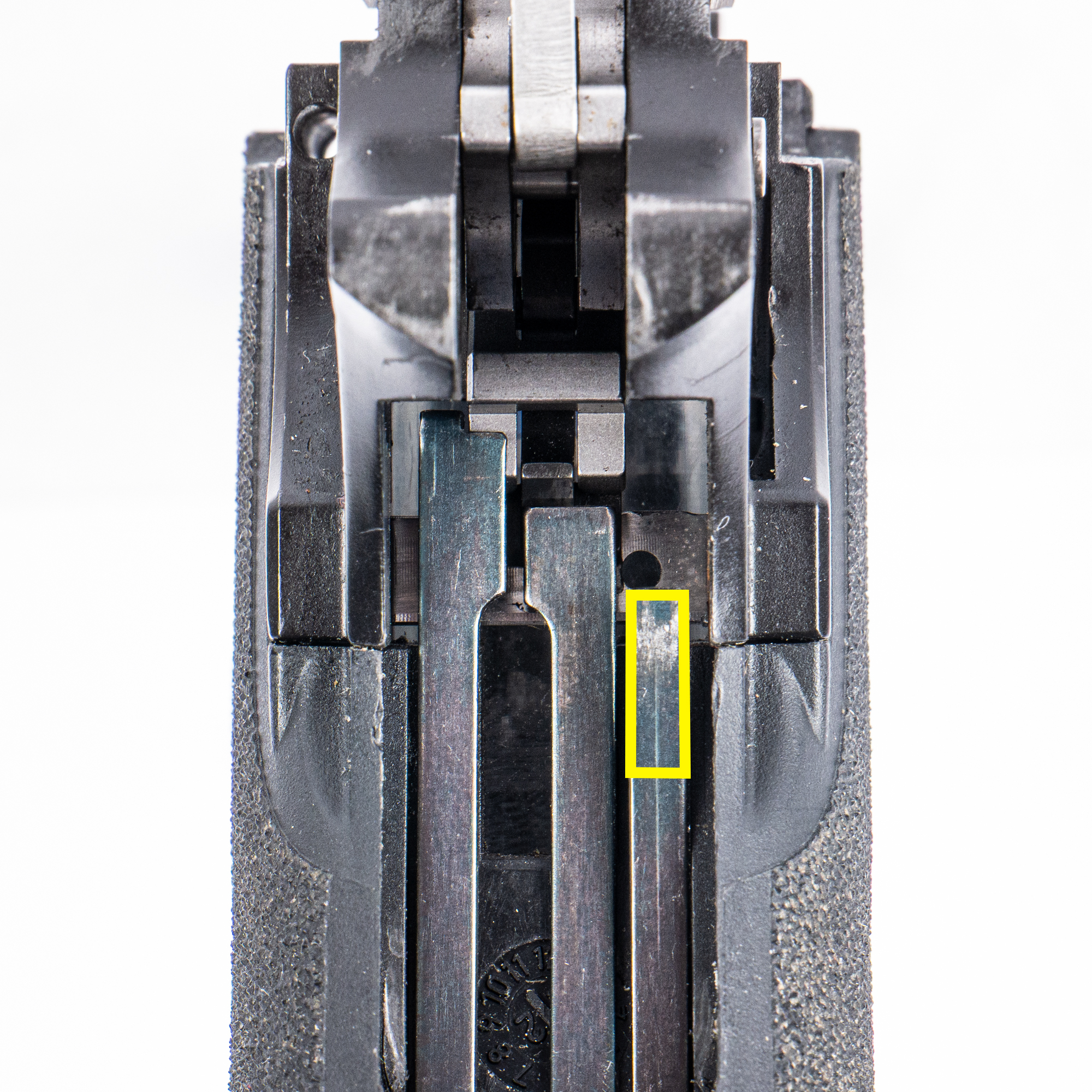
What too little right-leaf tension can cause
- A grip safety that rattles or feels loose.
- A grip safety that returns slowly, only partially, or not at all after the pistol is released.
- A grip safety that remains in the depressed position and therefore does not return to its intended trigger-blocking position.
- Inconsistent safety operation depending on pistol angle, movement, debris, or grip pressure.
What too much right-leaf tension can cause
- A grip safety that is unnecessarily difficult to depress.
- A pistol that will not fire reliably for shooters whose hand position does not fully depress the safety.
- Excess contact pressure and drag if the safety or spring contact surface is rough or improperly shaped.
- The false impression that additional spring force can correct an incorrectly fitted grip-safety blocking arm.
Right-leaf placement problems
During assembly, the right leaf can be trapped behind or beside the grip safety instead of bearing on its intended contact surface. The mainspring housing may still move into place, making the error easy to miss. Depending on where the leaf is trapped, the grip safety may remain depressed, may not move at all, or may have excessive tension.
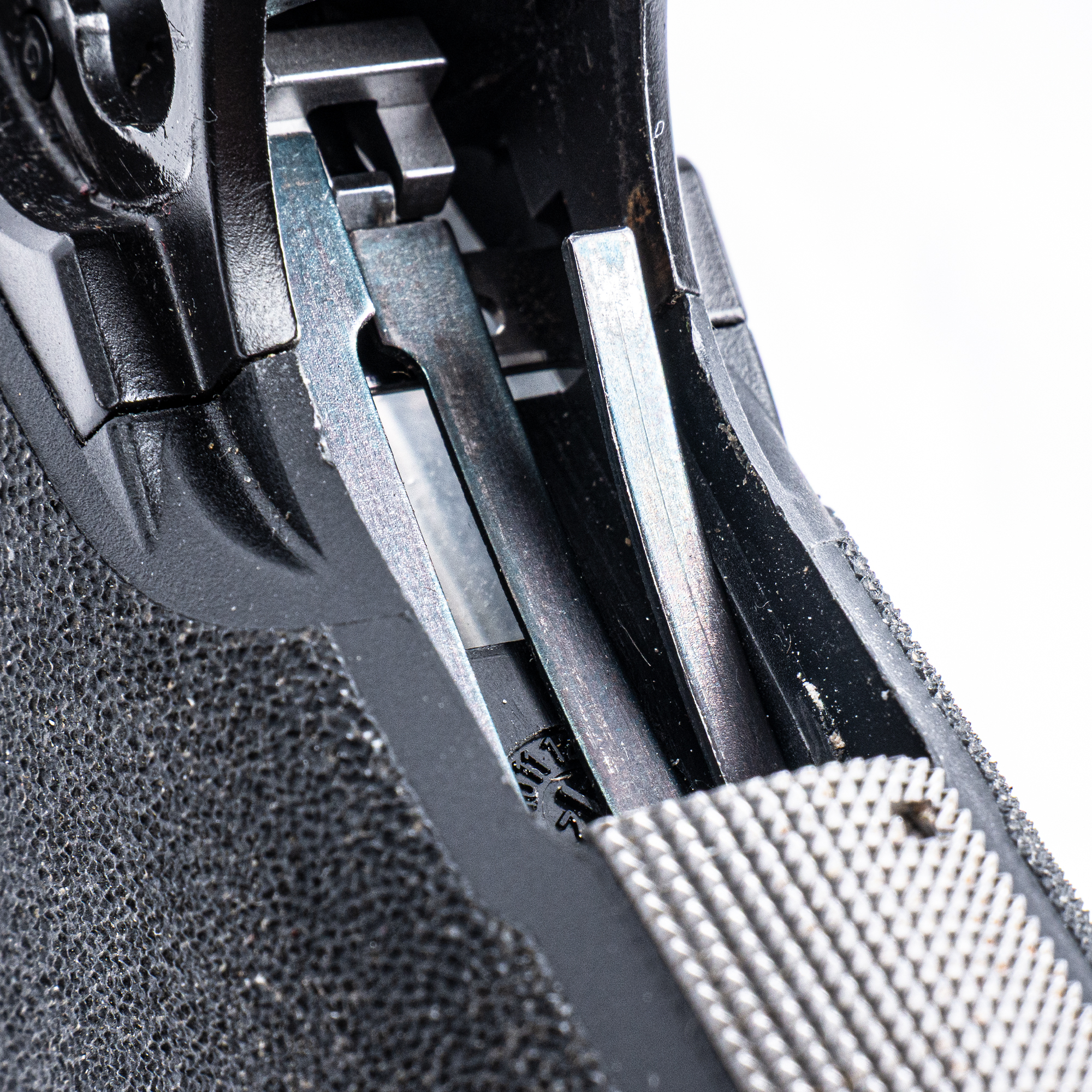
Spring pressure cannot compensate for an improperly fitted grip safety. The blocking arm must physically prevent trigger movement when the safety is out and clear the trigger bow when the safety is fully depressed. If that geometry is wrong, the safety requires proper fitting or replacement.
Why There Is No Universal “Correct Bend” or Tension Number
Sear-spring tension is sometimes discussed as if every pistol should use one exact measurement. In practice, a safe and reliable setup depends on the complete fire-control system and on how the measurement is taken.
The measured trigger pull can include several separate forces:
- Center-leaf pressure acting through the disconnector and trigger return system
- Left-leaf pressure acting on the sear
- Hammer-hook and sear engagement geometry
- Mainspring pressure acting through the hammer
- Trigger bow drag in the frame
- Disconnector friction or misalignment
- Overtravel and pretravel adjustment
- Series 80 firing-pin safety linkage, when present
- Grip-safety interference or incomplete depression
Published spring-weight methods also differ. Some measurements isolate only the center leaf. Others measure the center and left leaves together. Different fixtures, gauges, contact points, triggers, and component combinations can produce different readings. A number copied from another pistol is not a substitute for correct contact, adequate safety margin, and complete function testing.
Do not reduce sear-spring tension simply to reach a target trigger-pull number. A light pull produced by marginal sear or disconnector pressure is not a successful trigger job. The desired result is a clean, consistent pull with reliable hammer retention, positive disconnector operation, positive trigger reset, and fully functional safeties.
Common Sear-Spring Installation and Placement Errors
| Installation error | What it changes | Possible symptoms |
|---|---|---|
| Lower locating tab not fully seated in the frame slot | The entire spring can sit high, crooked, or move as the mainspring housing is installed | Inconsistent tension, leaves missing their parts, changing pull weight, reset problems, hammer follow |
| Left leaf behind, under, or only barely touching the sear | Removes or destabilizes sear-return pressure | Failure to cock, hammer follow, multiple shots, inconsistent break |
| Center leaf missing or improperly contacting the disconnector | Reduces or blocks disconnector movement and trigger return | Dead trigger, no reset, slow reset, unusually heavy or inconsistent pull |
| Right leaf trapped behind or beside the grip safety | Removes grip-safety return or prevents normal safety movement | Loose safety, safety remains depressed, safety will not depress, mainspring housing difficult to install |
| Left and center leaves crossed or rubbing | Couples two functions that should operate independently | Stacking pull, variable reset, changing pull weight, intermittent sear or disconnector operation |
| Spring or individual leaf twisted sideways | Changes contact location and introduces side drag | Gritty pull, inconsistent reset, leaves slipping off their contact surfaces |
| Mainspring housing forced into place | Can displace or buckle the spring instead of retaining it flat | Sudden change in tension, damaged leaves, abnormal safety or trigger operation |
| Hammer strut not aligned with the mainspring cap | Creates a separate mainspring and hammer problem that can be mistaken for a sear-spring issue | Abnormal hammer movement, binding, difficulty completing assembly |
What Repeated Bending Can Do to a Sear Spring
A leaf spring is designed to flex through a controlled range. Tuning changes its installed load, but repeated bending in opposite directions, sharp kinks, bending at the wrong location, or using tools that nick the surface can shorten its service life.
- Permanent set: The leaf no longer returns to its previous shape or pressure.
- Work fatigue: Repeated back-and-forth corrections can initiate a crack or lead to a broken leaf.
- Stress concentration: A sharp crease or tool mark concentrates stress in one small area.
- Side twist: The leaf may look correctly tensioned from the side but no longer contact its component squarely.
- Changed contact geometry: Altering a formed tip or pad can move the contact point, change leverage, or allow the leaf to slip off the part.
Inspect the spring for cracks, broken leaves, corrosion, rough or damaged contact surfaces, sideways distortion, and loss of tension. Replacement is usually the better choice when a spring has been repeatedly adjusted, kinked, damaged, or made unreliable. A sear spring is not the place to preserve a questionable part.
Symptom-Based Troubleshooting Guide
The chart below identifies spring-related possibilities, but it is not a substitute for a full diagnosis. More than one defect can produce the same symptom.
| Symptom | Possible spring cause | Other causes that must be checked |
|---|---|---|
| Hammer follows the slide | Low left-leaf tension, left leaf missing the sear, spring sitting too low, low center-leaf tension in a light-trigger system | Hammer and sear geometry, worn parts, disconnector damage, excessive trigger inertia, incorrect pretravel or overtravel, frame dimensions |
| Two or more shots from one trigger press | Defective, mispositioned, or inadequately tensioned sear spring | Worn, broken, or incorrectly fitted disconnector, sear, or hammer full-cock hooks. Stop using the pistol immediately. |
| Trigger does not reset | Low or misplaced center leaf | Trigger bow drag, debris, tight disconnector channel, burred disconnector, overtravel screw set too far |
| Trigger reset is slow or inconsistent | Marginal center tension, leaf rubbing the frame or another leaf | Dirt, rough trigger track, bent trigger bow, disconnector interference |
| Trigger pull is unusually heavy | Excess left or center tension | Hammer and sear geometry, heavy mainspring, trigger bow drag, Series 80 linkage, incomplete grip-safety depression |
| Trigger pull feels gritty or changes from pull to pull | Rough spring pads, sideways leaf twist, leaves rubbing, spring shifting in the frame | Burrs, dirty parts, rough engagement surfaces, trigger bow or disconnector drag |
| Grip safety rattles or stays depressed | Low right-leaf tension or incorrect right-leaf placement | Worn, damaged, or incorrectly fitted grip safety |
| Grip safety is difficult to depress | Excess right-leaf tension or leaf trapped in the wrong position | Safety-to-frame interference, incorrect blocking-arm geometry, debris or burrs |
| Grip safety does not block the trigger | Right leaf not returning the safety outward | Improperly fitted or damaged grip safety. Spring pressure alone cannot correct an undersized blocking arm. |
| Pull weight changes with grip pressure | Right leaf or spring body contacting parts incorrectly | Grip safety dragging on the trigger bow or incomplete clearance when depressed |
When the Sear Spring Is Not the Real Problem
It is tempting to bend a leaf whenever a trigger feels wrong. That approach can create a second problem while leaving the first one untouched. A sear spring should never be used to compensate for:
- Damaged, worn, incorrectly cut, or incompatible hammer and sear engagement surfaces
- A worn, burred, short, or incorrectly fitted disconnector
- An overtravel screw that prevents sufficient sear or disconnector movement
- Insufficient trigger pretravel in a setup that requires it for reliable reset and disconnector operation
- A bent, oversized, rough, or dragging trigger bow
- Incorrect sear-pin or hammer-pin location in the frame
- An incorrectly fitted thumb safety or grip safety
- Series 80 firing-pin safety parts that are rough, misaligned, or incorrectly timed
- A mainspring housing, hammer strut, or mainspring problem
- Debris, dried lubricant, corrosion, burrs, or damaged contact surfaces
A particularly important example is hammer follow. More left-leaf tension may appear to make the hammer stay cocked during a casual bench check, but the underlying problem could still be unsafe engagement geometry. The correct repair is to diagnose the entire ignition system.
Inspection and Safety Checks After Sear-Spring Work
Any time the sear spring, hammer, sear, disconnector, trigger, thumb safety, grip safety, or mainspring housing is changed or adjusted, the pistol's complete fire-control and safety system must be evaluated. At minimum, a qualified person should confirm:
- The spring's lower tab is fully seated and the spring lies flat against the frame.
- Each leaf remains on its intended component through the component's full movement.
- The leaves do not cross, rub each other, or drag on the frame.
- The hammer remains securely at full cock when the slide is operated normally.
- The trigger returns positively and the disconnector functions correctly.
- The grip safety returns positively and blocks trigger movement when not depressed.
- The thumb safety positively blocks the sear and does not allow the hammer to fall when disengaged after being tested.
- The half-cock or safety position functions as designed for that specific hammer.
- Pull weight is consistent and appropriate for the pistol's intended use.
- All checks are repeated after the pistol is fully assembled, because the installed mainspring housing and safeties can change how the parts interact.
Perform bench checks only with the pistol completely unloaded and all ammunition removed from the area. If the hammer follows, the trigger does not reset positively, the disconnector does not operate correctly, either safety fails, or any result is inconsistent, stop. Do not attempt a live-fire confirmation of a known malfunction.
Choosing an EGW 1911 Sear Spring
EGW offers several sear-spring options for different builds and preferences. All fire-control parts require correct installation and verification. Minor fitment or tuning may be required, and any spring used in a defensive, duty, or competition pistol should be checked as part of the complete ignition system.
EGW Evolved 1911 Sear Spring, 2-Pack
Our most developed general-purpose option for 1911 and 2011 pistols. The left finger is more than .030 inch longer to improve sear contact in frames with a low sear-spring slot. A relief cut reduces the chance of the left side rubbing the frame. Reduced-mass sear and disconnector contact pads, plus narrower center and right leaves, are designed to reduce unnecessary moving mass while retaining the intended contact surfaces.
EGW Evolved 1911 Sear Spring, 10-Pack
The same Evolved spring in a shop-friendly 10-pack. This is the practical choice for professional gunsmiths, competitive shooters who maintain several pistols, and builders who want consistent replacement springs available at the bench.
1911 Lightened Leaf Sear Spring
Made in the USA from drawn and tempered high-carbon steel, this spring uses skeletonized leaves and is intended for light, match-quality trigger systems. It is best suited to a properly fitted competition or precision build where the complete ignition system will be tuned and verified by someone experienced with 1911 fire-control work.
Genuine Colt 1911 Sear Spring
A proven, traditional Colt spring with weight-reduced left and center prongs. This is a strong choice for builders who prefer an established factory-style spring and Colt's recognizable heat treatment and finish.
A note about the Evolved spring's finish
EGW does not glass-bead or sandblast Evolved sear springs after heat treatment. The heat-treating process can leave a spotty or uneven-looking finish. This appearance is not rust and does not affect the spring's performance.
Frequently Asked Questions
Does the sear spring control the entire trigger pull weight?
No. The left and center leaves contribute to trigger pull weight, but hammer and sear geometry, mainspring pressure, trigger bow drag, disconnector friction, firing-pin safety parts, and trigger adjustments also contribute. Reducing spring tension is only one part of a correctly executed trigger job.
Which finger controls trigger reset?
The center finger. It acts on the disconnector and supplies the force that helps return the trigger system forward. A weak reset can result from insufficient center-leaf tension, but drag or interference elsewhere can produce the same symptom.
Which finger can cause hammer follow?
The left finger is the primary spring-related concern because it supplies sear-return pressure. However, very low center-leaf tension can also contribute in a light-trigger system by allowing unwanted trigger movement or poor disconnector operation. Hammer follow can also be caused by hammer, sear, disconnector, trigger, or frame problems, so it requires a complete diagnosis.
Can I fix hammer follow by bending the left finger forward?
Do not assume that additional left-leaf tension is the correct repair. It may change the symptom, but hammer follow can indicate unsafe hammer and sear geometry, a damaged disconnector, excessive trigger inertia, or dimensional problems. Keep the pistol unloaded and have the entire ignition system inspected.
Why does my grip safety rattle?
The right leaf may not be supplying enough return pressure, or it may not be correctly positioned on the grip safety. The grip safety itself may also be worn or improperly fitted. The safety must return positively and must block the trigger when released.
Should the left and center leaves touch each other?
They should operate independently and should not rub or cross through their working movement. Contact between the leaves can change the pull, sear pressure, and reset characteristics as the trigger moves.
Are 1911 and 2011 sear springs the same?
Many traditional three-leaf springs work in both platforms, but frame and grip-module dimensions can vary. The EGW Evolved 1911 Sear Spring is specifically listed for both 1911 and 2011 pistols. Every installation still requires verification of actual leaf contact and complete safety function in the specific pistol.
Does a new sear spring drop in without fitting?
Do not treat a sear spring as a guaranteed drop-in fire-control part. Minor fitment or tuning may be required, and correct placement, adequate tension, trigger reset, disconnector operation, hammer retention, and both safeties must be verified after installation.
Final Takeaway
A properly functioning 1911 sear spring is a balance of three separate jobs. The left leaf must return the sear with enough authority to support reliable hammer retention. The center leaf must raise the disconnector and return the trigger positively. The right leaf must return the grip safety to its blocking position without making it unnecessarily difficult to depress.
The goal is not simply the lightest possible spring tension. The goal is correct contact, independent movement of all three leaves, consistent trigger operation, reliable reset, secure hammer engagement, and fully functional safeties. If any part of that system is uncertain, keep the pistol unloaded and consult a qualified 1911 gunsmith.
Newest Guide & Blog Updates
1911 Sear Spring Guide: Finger Function and Problems
The Complete Guide to the 1911 Sear Spring: What Each Finger Does and What Can Go Wrong The 1911 s...
Tired of Waiting on Beretta Factory Plates? Upgrade to EGW Direct Replacements
Upgrading Your Beretta 92 RDO: The Ultimate Direct-Replacement Optic Plates Tired of waiting on fact...
How to Verify Ruger No.1 Scope Rail Fitment Before Ordering
Ruger No.1 Scope Rail Fitment Guide How to use the EGW Ruger No.1 Radius Gauge and Hole Spacing Gu...

Marlin 1895 Mounting Solutions: The Ultimate Guide to Modernizing Your Lever Gun
Marlin 1895 & Henry Lever Action Mounting Solutions: Picatinny Rails, Scope Mounts & Red Dot Option...

Springfield Prodigy Mag Catch Upgrade - EGW HD Machined Tool Steel
Springfield Prodigy Mag Catch Upgrade: EGW HD Machined Tool Steel The ultimate upgrade for reliable...

Why Fully Machined 1911 Ignition Components Outperform MIM
The Heart of the Crisp Break: Why Fully Machined Ignition Components Outperform MIM In the world o...