
The Ultimate Guide to Scope Ring Height: How to Choose the Perfect Rings
One of the most common questions we get from shooters is, "what height scope rings do I need?" It’s a critical question because the right scope ring height is essential for accuracy, comfort, and protecting your equipment. Choosing incorrectly can lead to a scope that’s mounted too high, damaging your cheek weld, or worse—a scope objective that’s jammed against your rifle barrel.
This scope ring height guide is designed to eliminate the guesswork. We'll show you exactly how to choose scope ring height using our comprehensive chart, which acts as an easy ring height calculator.
Why is There No "Standard Ring Height"?
First, let's clear up a common misconception. While many brands offer "Low, Medium, and High" rings, there is no universal standard ring height. A "Low" from one company might be a "Medium" from another. This is why determining scope ring height can be so frustrating.
The difference comes down to how to measure scope ring height. At our company, we measure from the highest point on the Picatinny or Weaver rail to the dead center of where the scope will sit. This measurement gives you a precise understanding of your scope height and ensures a proper fit.
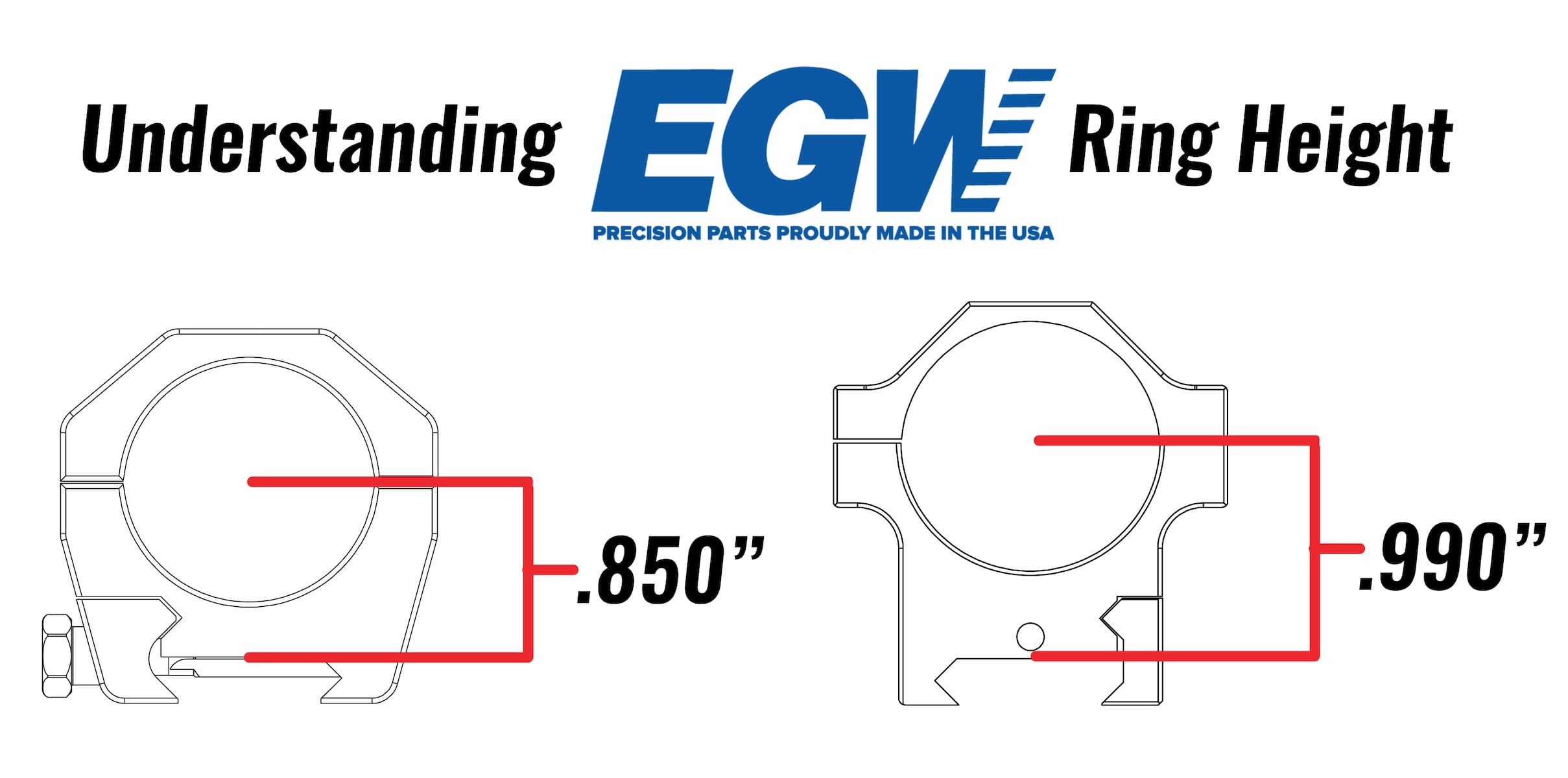
Your Easy-to-Use Scope Ring Height Calculator
Forget complicated math. The best scope ring calculator is a simple chart that does the work for you. By knowing your scope's main tube diameter and its objective lens size, you can instantly find the perfect rings.
Below is our definitive scope ring height chart. Simply find your scope’s tube size and objective lens size to find the right rings.
For 1-Inch Tube Scopes
| Your Ring Height | Common Name | Recommended For Objective Lens Sizes | Best Use Case & Notes |
|---|---|---|---|
| .850" | Low | Up to 44mm | Perfect for scopes with 40mm or 44mm objectives. This provides a desirable low-profile fit on most standard hunting rifles. |
| .990" | Medium | Up to 50mm | A versatile, all-purpose height for the most popular 50mm objective scopes. This is our most common recommendation. |
| 1.275" | High / AR-Height | Excessively Large Objectives | This height is for scopes with very large objectives, or for mounting on a flat-top rifle like an AR to achieve proper eye alignment. |
For 30mm Tube Scopes
| Your Ring Height | Common Name | Recommended For Objective Lens Sizes | Best Use Case & Notes |
|---|---|---|---|
| .850" | Low | Up to 50mm* | Can work for objectives up to 50mm, but *clearance may be very tight depending on the rifle's barrel contour and receiver height. A great low-profile option for 44mm objectives. |
| .990" | Medium | Up to 56mm | The safest choice for 50mm objectives, ensuring good clearance on virtually all rifles. Also provides ample room for lens caps. |
| 1.275" | High | 50mm to 56mm | This height is for scopes with very large objectives, or for mounting on a flat-top rifle like an AR to achieve proper eye alignment. |
For 34mm Tube Scopes
| Your Ring Height | Common Name | Recommended For Objective Lens Sizes | Best Use Case & Notes |
|---|---|---|---|
| .990" | Low | Up to 56mm | Specifically designed to mount powerful scopes with 56mm objectives as low as possible to the rifle's bore, which is ideal for precision. Note: If you have a long action rifle we suggest going with our medium height rings |
| 1.275" | Medium | 56mm and up | For 56mm objectives when more clearance is needed for a heavy barrel, long action rifle, a 20 MOA base, or larger lens caps. |
| 1.500" | High / AR-Height | 56mm+ / Flat-Top Rifles | For scopes with objectives larger than 56mm, or for mounting on an AR-platform rifle to achieve a comfortable and effective cheek weld. |
⭐ Important Disclaimer: This chart is a reliable guide for most standard bolt-action rifles. However, the ideal height can be affected by factors like a thicker-than-standard barrel (heavy or varmint contour), or a specific rifle's stock design. When in doubt, it is always safest to choose the next size up.
Scope Ring Height Calculator
Using the Calculator
Enter Objective Diameter, Tube Diameter, and Base Height (use 0.400" for most EGW rails) in inches or mm. Click "Calculate" for the recommended ring size. The calculation includes a 4mm tube thickness allowance but may not account for factors like scope covers, bolt clearance, or barrel contour. Ensure the scope does not contact the rifle.
Result
Frequently Asked Questions about Scope Ring Height
Q: Is it better to have the scope as low as possible?
A: Generally, yes. Mounting the scope as close to the rifle's bore as possible (without touching the barrel) is ideal for long-range accuracy and promotes a better cheek weld. The only major exception is for AR-platform rifles, where higher rings are needed to achieve a comfortable and natural head position.
Q: What happens if my rings are too high?
A: If your rings are too high, you will have to lift your head off the stock to see through the scope. This makes it very difficult to get a consistent "cheek weld," which is the foundation of good marksmanship and is critical for accuracy.
Q: Do I need different height rings for a 20 MOA base?
A: Sometimes. A 20 MOA base is slightly thicker at the rear than at the front. While our charts account for this in most cases, if your scope has a very large eyepiece, it could potentially interfere with the angled base, requiring slightly higher rings.