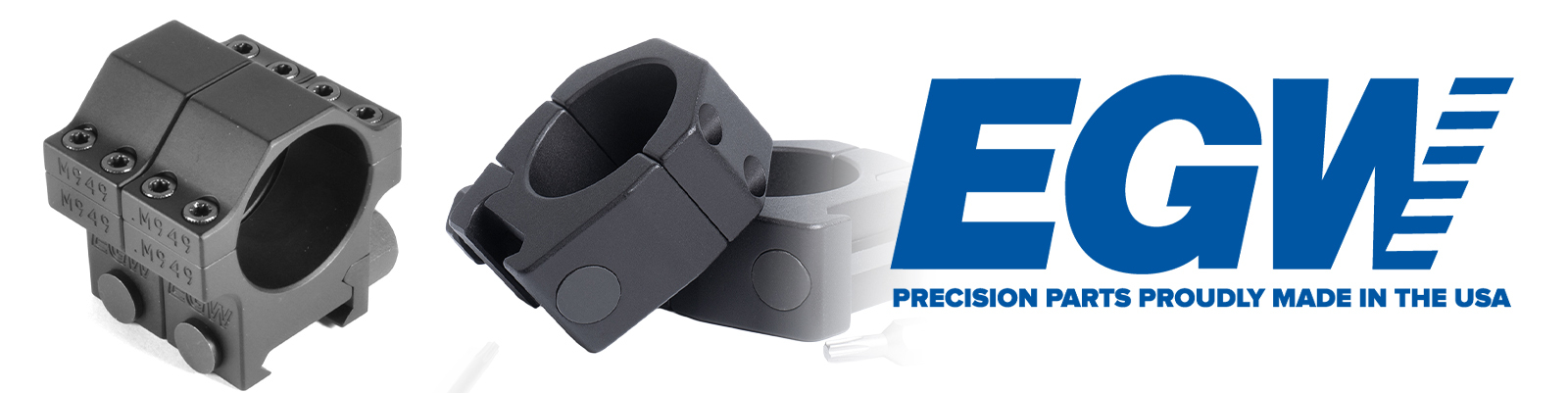
Shop premium rifle scope rings in 1", 30mm, and 34mm diameters. Proudly CNC-machined in the USA for MIL-STD-1913 Picatinny bases to deliver rock-solid strength and a secure zero under heavy recoil.
• 1-Inch Tubes: Use 0.850" Low for objectives up to 44mm; 0.990" Medium for up to 50mm.
• 30mm Tubes: Use 0.850" Low for tight 44mm profiles; 0.990" Medium for up to 56mm objectives (safest choice).
• 34mm Tubes: Use 0.990" Low for precision 56mm tracking; 1.275" Medium for heavy bull barrels or 20 MOA bases.
*Note: For flat-top AR platforms or chassis setups, select 1.275" to 1.500" High clearances to ensure clean eye-box centering.
Scope rings are the critical mechanical connection between your optic and your rifle receiver. High-quality rifle scope rings ensure exact bore alignment, secure mounting under violent recoil impulses, and an absolute return-to-zero baseline. This comprehensive guide details tube diameters, centerline heights, installation torque specs, and how to pick the right platform.
Scope rings are precision-engineered split clamps that grip your optic's main tube housing and securely mate it to a rifle's top rail base—most commonly a standard cross-slot Picatinny mount platform. Their role is to transform the optic and firearm into a single unyielding unit, preventing physical drift or longitudinal shifting during repeat firing cycles.
Opting for premium machined rings shields your scope from uneven pinching stresses, concentricity distortion, or physical marring while preserving critical internal tracking alignments.
The primary filter when choosing scope rings is identifying your optic's central main tube diameter size. Rings must fit the tube precisely; mismatched sizing prevents uniform clamp torque and risks completely crushing the internal scope mechanics.
Ring height determines how close the body of your scope sits to your firearm's action and barrel sleeve contour. Proper sizing creates a reliable line-of-sight while allowing full freedom for objective bells and objective flip caps.
At EGW, we standardize our scope ring height by measuring directly from the top horizontal face of the Picatinny rail base up to the absolute center axis of the main tube bore ring. This methodology eliminates variance across different receiver profiles.
True cross-bolt Picatinny scope rings interface directly with standard MIL-STD-1913 rails, presenting considerable structural advantages over traditional dynamic dovetails or proprietary turn-in styles:
Every set of EGW scope rings is precision CNC machined directly in our Quakertown, Pennsylvania manufacturing facility. We start from premium solid aluminum extrusion baselines to guarantee optimal geometric alignment, structural uniformity, and flawless parallel mating surfaces across the scope tube.
By maintaining tight control over tolerances throughout production, we ensure our rings provide uniform, concentric clamping forces. This guarantees that your rig maintains its zero under field use and competition conditions.
Adhering strictly to uniform torque profiles ensures a secure lock without stressing your optic or stripping mounting threads:
Keywords: scope rings, rifle scope rings, Picatinny scope rings, EGW scope rings, scope ring height, scope ring torque, precision scope rings, tactical scope rings, best scope rings
