
Why Fully Machined 1911 Ignition Components Outperform MIM
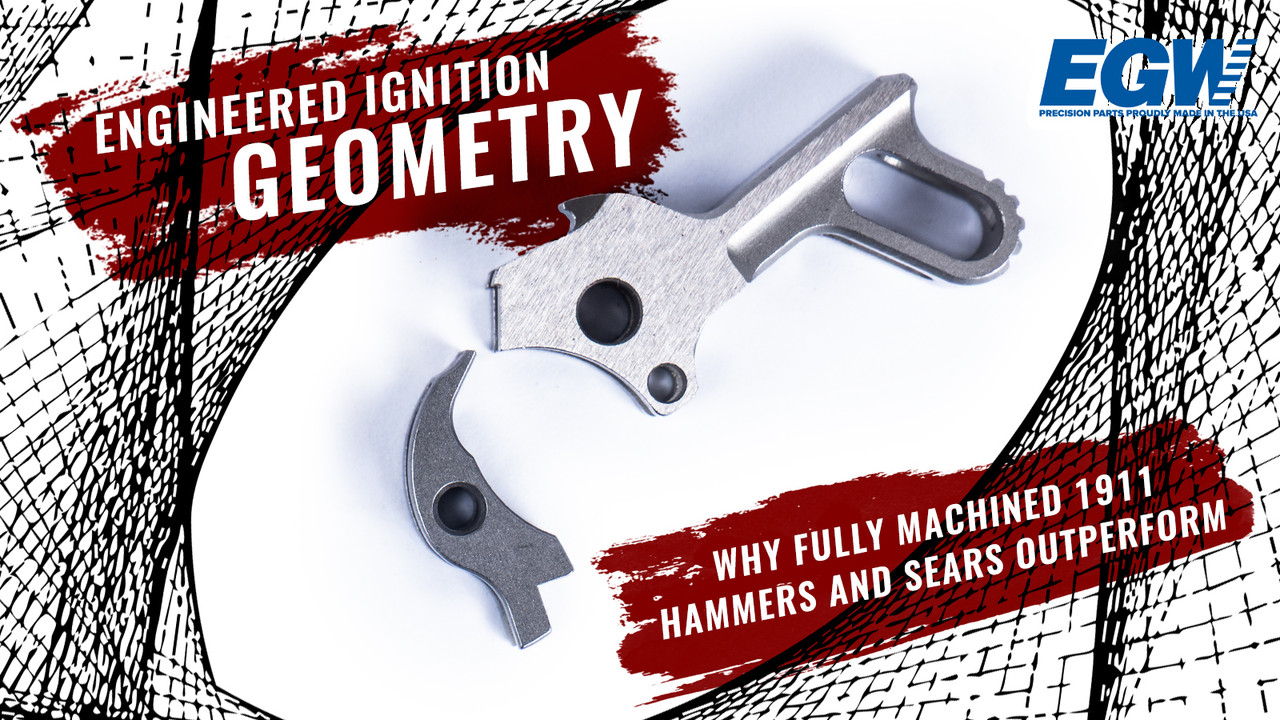
The Heart of the Crisp Break: Why Fully Machined Ignition Components Outperform MIM
When it comes to a 1911 trigger, everything comes down to two small surfaces: the contact points between the hammer hooks and the sear nose. Those surfaces control trigger pull weight, creep, break quality, reset feel, long-term reliability, and safety.
At Evolution Gun Works (EGW), we fully machine our 1911 hammers and sears from solid tool steel. That decision is not marketing. It is engineering.
The Critical Contact: Hammer Hooks and Sear Nose
In a 1911, the hammer hooks rest on the sear nose under spring pressure. When you press the trigger, the sear rotates and releases the hammer. That is the entire control point for ignition. On a 1911, a few thousandths of an inch can be the difference between a crisp, repeatable break and a trigger that feels gritty, inconsistent, or unpredictable.
What matters at these contact points:
- Hammer hook height must be consistent.
- Hook faces must be square and true.
- Sear nose angle must be precise.
- Engagement depth must be correct.
- Surface finish must be clean and uniform.
What it looks like
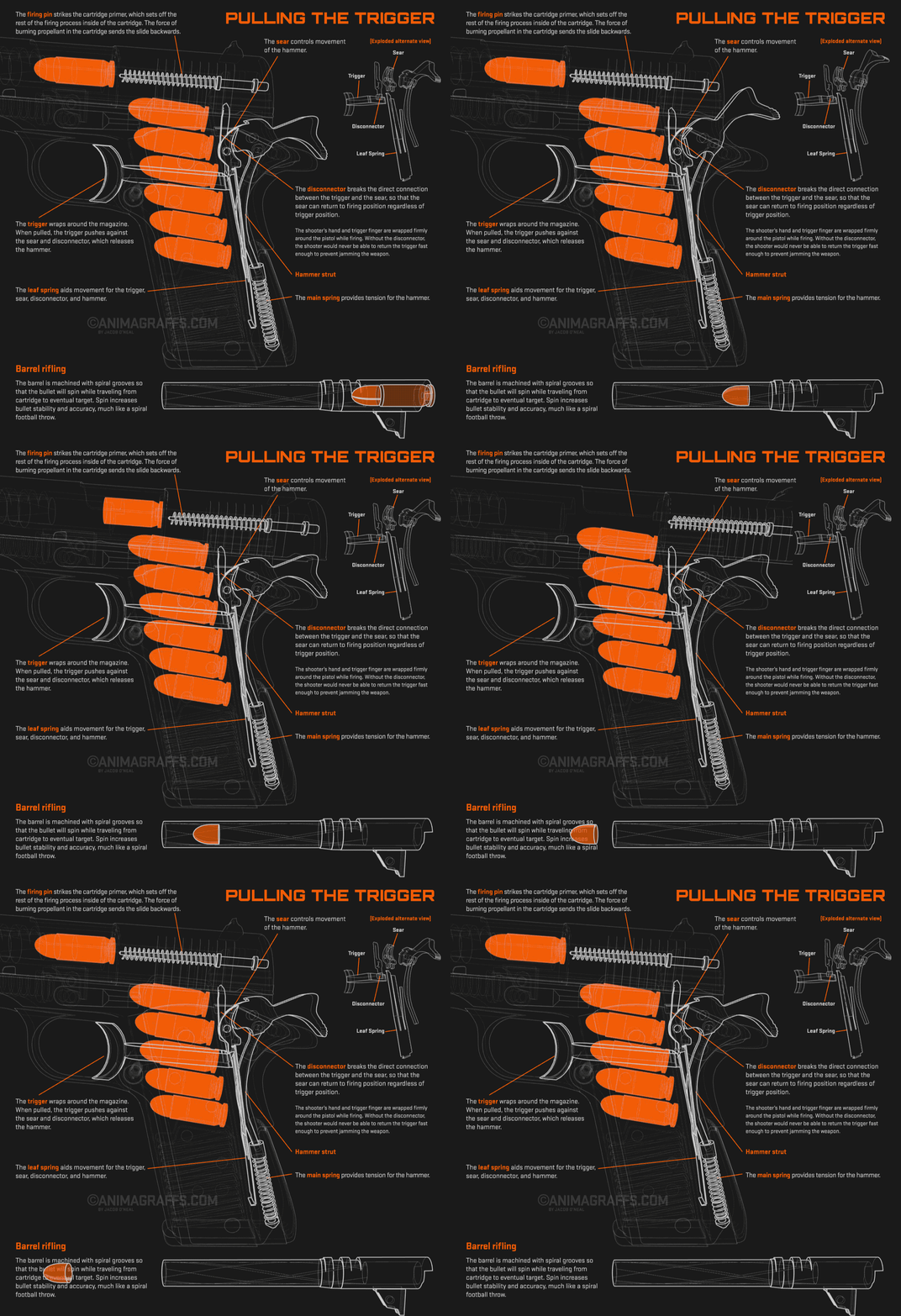
Credit: Jacob O'Neal
Fully Machined From Solid vs MIM
Many factory 1911s use MIM (Metal Injection Molded) components. This process involves injecting metal powder and a binder into a mold. While cost-effective, it introduces tradeoffs when you are dealing with critical engagement surfaces.
1) Dimensional consistency where it matters most
MIM parts shrink during the sintering process. While manufacturers account for it, shrink is not always perfectly uniform. Small variations in hook height and surface flatness show up at the trigger. When a part is machined from solid tool steel, critical geometry is cut directly on precision CNC equipment. Heights, angles, and surfaces are controlled.
2) Surface integrity and longevity
Hammer hooks and the sear nose are bearing surfaces under constant spring pressure. A fully machined tool steel surface provides a more uniform structure and predictable hardness. This leads to cleaner breaks, less creep, and better long-term wear characteristics.
| Feature | Standard Factory MIM | EGW Fully Machined |
|---|---|---|
| Material Integrity | Porous metal powder/binder | Solid tool steel bar stock |
| Surface Finish | Often requires heavy stoning | Precision ground and polished |
| Geometry | Near-net shape (molded) | Engineered mating surfaces |
Engineered for Synergy
At EGW, our hammers and sears are not just machined individually; they are engineered as a system. Hook height, sear geometry, and engagement depth are designed to complement one another. When components are engineered to work together from the start, the end result is a trigger that breaks cleaner and stays consistent.
What a Precision 1911 Trigger Feels Like
A properly engineered hammer and sear set produces a "glass rod" break. By eliminating the flex and surface friction common in factory parts, our sets provide:
- A defined wall
- Minimal creep
- A crisp, predictable break
- A short, positive reset
The goal is not just a light trigger. The goal is a safe, repeatable, and clean trigger that performs the same way shot after shot, thousands of cycles later.
Don't settle for a trigger that fights you. Upgrade to components that were engineered from the start to be the best. In a 1911, geometry is the foundation. We machine our hammers and sears from solid because the contact points matter.
Looking to upgrade your 1911 fire control parts?
Explore EGW’s fully machined 1911 hammers and sears and build a trigger you can trust. Shop now
Newest Guide & Blog Updates
Why Fully Machined 1911 Ignition Components Outperform MIM
The Heart of the Crisp Break: Why Fully Machined Ignition Components Outperform MIM In the world o...
EGW CZ Scope Mounts: Converting Dovetail Rails to Picatinny
EGW CZ Scope Mounts – Why CZ Dovetail Rails Are Different (and Why Shooters Love Them) CZ rifles ha...
Is Your Shotgun Ready for Spring Turkey?
Gear Up for Gobblers: The Ultimate Guide to EGW Turkey Hunting Parts "The margin for error in the tu...
Which Browning X-Bolt Scope Base Do I Need? (X-Bolt I vs. X-Bolt II)
Browning X-Bolt vs. X-Bolt II: The Definitive Guide The release of the Browning X-Bolt II has broug...
Holosun 509T Mounts – EGW RMR Dovetail & Picatinny Solutions
Holosun 509T + EGW RMR Mount The Toughest & Most Affordable Setup in 2025 If you are looking for t...

The Ultimate Guide to Long-Range Rimfire Bullet Drop (And What MOA Rail You Need)
From 50 to 400 Yards: The Ultimate Guide to Rimfire Bullet Drop & Why You Need an MOA Rail Long-ran...